
A cerebral spectacle
Some thoughts on the 2026 Dylan Thomas Prize-shortlisted novel by Harriet Armstrong, ‘To Rest Our Minds and Bodies’.

“Like an exclamation mark, which adds something jovial and upbeat to a statement, ‘lol’ indicates that a sentence should be taken less seriously—but this often feels like a sort of mutually understood but unacknowledged mask. Often ‘lol’ conveys a near-explicit desperation to connect,” writes Harriet Armstrong in her Granta essay, Lol I’m trying to tell you how it feels for me.
Those of us who chat, involving ourselves in that seemingly pointless means of conversing with others—an exercise where emotions can be hidden via emojis and GIFs help save us from embarrassing ourselves, keeping everything light alongside alluding remotely what we want to convey, may or may not know how this insidiously harmless activity not only opens up possibilities for miscommunication, but also affects our ability to express ourselves.
In concealing what we truly intended to convey and by projecting a version of who we are for the purposes of this assumed pact of ‘keeping it light’, we burden ourselves. In the Granta essay, Armstrong argues the same. Or so I propose. Because anything otherwise would introduce the concepts of care and need, which no one supposedly presumes to do on a chat.
From the essay again: “I thought of the ending of Ben Lerner’s 10:04: ‘I know it’s hard to understand / I am with you, and I know how it is.’ Maybe the best ‘lol’ texts do something like that: they speak to something which might be complex, or go unspoken for whatever reason, and they acknowledge that context without needing to explain it. They neither deflect nor fully disclose; they don’t need to, because both the sender and the recipient understand it all already. ‘Lol yes of course I know.’”
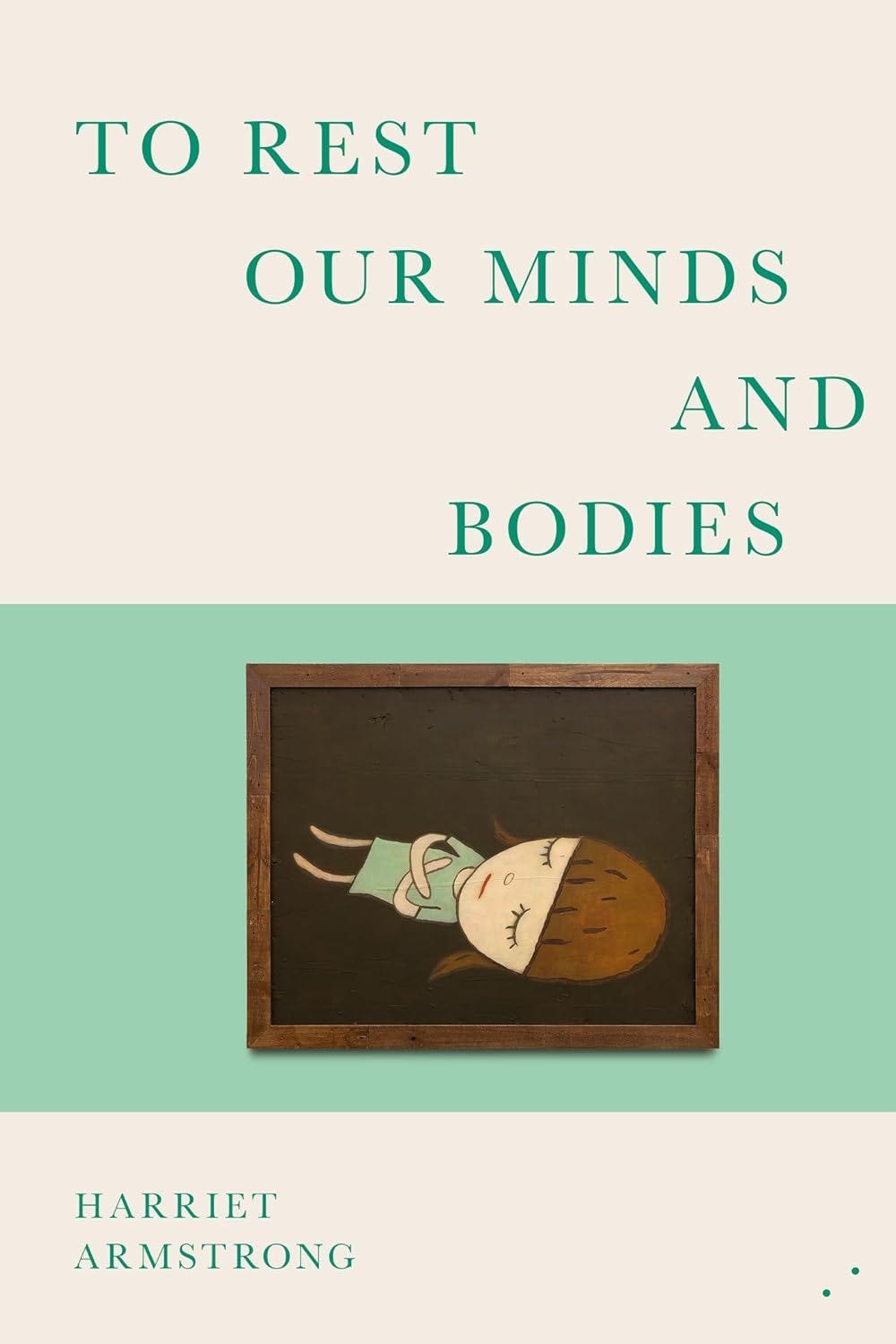
It’s this knowability that’s put to task in Armstrong’s debut novel, To Rest Our Minds and Bodies (Les Fugitives, 2025). It’s this casual way one dismisses one’s feelings in the interest of not getting labelled a ‘serious type’ that’s explored in the book by an unnamed narrator, a final year psychology major.
In expressing the tirade of emotions of this young girl as she navigates first love and heartbreak, trying to make meaning out of her engagement with arts, literature, and pop culture, Armstrong ably situates herself among the chroniclers of an anxiety-ridden contemporary youth.
The restless mind
This 2026 Dylan Thomas Prize-shortlisted novel begins with the narrator “on holiday with [her] family”, arguing about “the air conditioning” with her brother, sleeping badly, and giving title to one of her “stupid dreams”, “Floorless, like flawless”.
If a reader fails to register the inherent fluidity of this novel through the invocation of dreams in the first paragraph itself, floating follows immediately, cementing this work of stream of consciousness at the heart of body and cerebral politics.
The restless young girl then shares a litany of self-critical remarks, expressing her desperation at acquiring knowledge, though she isn’t entirely convinced where she’s going to utilise it. Perhaps that’s what youth is about, trying to find a key to a passage that hasn’t presented itself, yet one tries. And in this triage that’s expressed wonderfully by Armstrong, making one feel as if they’re accessing a secret diary that the narrator maintains, in which select expressions invoke in the reader—the voyeur?—an urgency that gets them involved in the action.
For example, here’s what confused the narrator in a literary society’s meeting. Someone notes that if Frank O’Hara “hadn’t written poetry he would have died. He kept saying I mean rhetorically of course and another boy kept saying No no he really would have died, you have no idea”. The narrator “couldn’t work out if the whole conversation was a joke”. Eventually, she submits: “I really had nothing to say about Frank O’Hara’s imaginary death or anything else, it was terrible.”
If the narrator’s expression doesn’t exhibit the duality in typing away ‘lol’ in response to something she can’t allow herself to be deeply involved with because it’s clearly affecting her too much, then what else does? It’s no wonder that select fragments of Frank O’Hara’s poems become the narrator’s “default thought”.
The ‘terrible’ and the ‘amazing’
The narrator’s preoccupations shift when she meets Luke, the one whose “passive face” appeared “strikingly similar to Tilda Swinton”, who has a girlfriend, and was studying computers.
Though she realises it “was hard to know what it was that [she] wanted to learn” in another context, it appears that she may as well feel that to be the case with everything she was coming across, as if nothing could be devoid of meaning; that she was failing at this task of scouting for significance, this attempt at absorbing herself into something and enjoying herself at the same time, as if she wanted to imitate a super-engaged spectator observing a game of Chess believing themselves to be the one who has everything at stake, and not the players themselves.
This overwhelming feeling is terrible for her, but in its revelation, in Armstrong’s masterly prose, is amazing for the reader.
On her thoroughly absorbing debut, I had the opportunity to discuss with the author what she intended to do with her restless narrator. (See Interview | ‘I Was trying to push boundaries writing about sex’: Harriet Armstrong on The Hindu website.)
To give a flavour of how Armstrong allows readers to enter the head of the unnamed narrator, here are two meta references from the book.
A mention of the 2018 Man International Booker Prize-winning novel Flights (Fitzcarraldo Editions, 2017) by Olga Tokarczuk, which was translated from Polish into English by Jennifer Croft.
Really the novel was about motion and time and meaning and history, lots of the characters were historical, there was a seventeenth-century anatomist and a nineteenth-century pianist and the pianist was actually Chopin. I didn’t understand how Olga Tokarczuk had done that, how she had constructed a novel which was so ambitious in scope that it wasn’t about just some person at all, it was about concepts.
This paragraph ends with the narrator noting that if she would happen to write a novel “about some girl” then it’d be “a completely unconceptual novel trapped inside the limited mind of some girl, I was sure of that.”
On a train journey to Luke’s party, the narrator is reading My Year of Rest and Relaxation (Penguin Press, 2018) by Ottessa Moshfegh.
[In her interviews] Ottessa Moshfegh said that the historical and geographical context of that book felt arbitrary to her, 9/11 happens in the book for example but it wasn’t the point at all. Really it was a novel about what it is like to exist and to know that you can only be one person. That could happen anywhere at any time, that experience. She was right about that, situational details and objects and people were just random, like props to illustrate how it felt to be desperately alone inside your body and your mind and the world.
The Flights reference helps readers notice how To Rest Our Minds and Bodies is essentially a novel of ideas and concepts, though it may give away a feeling that it is just about what this unnamed narrator is overwhelmed by, and has got nothing to do with what she’s thinking—and expressing—about. In the sense, she’s failing to express; however, her inexpressibility is in itself a submission.
Then, the 9/11 reference from Moshfegh’s interviews make one appreciate that often seemingly direct submissions doesn’t mean that they’re the point that’s being made; the exercise in itself is a deceptive allusion. Or often a motivated one: for example, the death of singer and songwriter SOPHIE, which is invoked in the novel. SOPHIE died during the novel coronavirus outbreak, which doesn’t find a direct reference in Armstrong’s novel. Try imagining what would’ve happened if a direct reference would’ve been allowed to slip in? It’d have convinced readers that the isolation and loneliness during the pandemic may have had an impact on this unnamed narrator, rendering an altogether different reading of the novel.

How challenging or fun was it for Armstrong to invoke these references? A lot, it seems, judging from her response over an email to this question.
I liked invoking these things because it felt playful, to me, to include works the narrator is reading and thinking about while she’s trying to present her own life as narrative—I liked the idea of having her consider the ways in which ‘the book she would write’ might fall short of the ones she’s reading, or alternatively, might align with them. It also felt honest, to me, in that—while writing a novel, or thinking about writing one, as my protagonist is doing—of course you’re thinking about existing novels all the time, and evaluating yourself in comparison to them, and getting inspired by them—and likewise, while reading a novel, you’re comparing it to other novels you like or dislike, and placing it in relation to all kinds of other thoughts and ideas. I liked the idea of doing a bit of that more explicitly within the book itself, particularly since the narrator uses books and music to help her interpret her life and offer her a sense of meaning.
Besides the questions I had asked Armstrong exclusively for The Hindu, there were others I had, which I posed to her only to satiate my curiosity about the unnamed character’s motivation in the face of events. Here they are:
When the unnamed narrator meets Richard, the latter makes a show of how he is being generous during the intercourse. We’ve Luke, who seems entirely incomprehensible regarding what he wants. Then, there’s Nick, who is generous with his mansplaining. Often, one gets to hear What women want, but it appears that men haven’t figured that out for themselves either, but they frequently project their unknowability as a failure of the other gender to do so. Something that inspires much purchase on manosphere where rejection to hold a space for expressing tenderness and afford vulnerability is celebrated as a win. Your thoughts?
Ah, I think the narrator’s attitude to sex and dating is a bit too myopic for the novel to really speak to that, though it is an interesting question! I think, within the book, I was interested in the way she ends up in a lot of situations which escalate towards sex very quickly—and she is simultaneously very active in seeking out those sorts of situations, and broadly disinterested in, and frightened by, the prospect of sleeping with the men in question. She’s coming to these sexual encounters with so many emotions and fears relating to herself, and to her feelings for Luke, that the encounters ultimately can’t reveal much—though of course they are also very stressful and full of men acting in disingenuous or presumptuous ways! I think the book contains this strong implicit belief, on the part of the protagonist, and maybe me as author, too, that there is a perfectly tender, mutual and honest way of having relationships with men, in which the body and mind can align completely, but this ideal is somehow inaccessible, for oblique and deeply individual reasons.
Throughout the book, the character feels barred from understanding sex, and from experiencing mutual love with Luke, and she can’t quite work out why, though she does know that meaningful sex and tender love exist.
The fire extinguisher scene struck me because I felt that surveillance in universities has become a norm, so the administration could’ve easily checked via CCTV who did what, which is why I was desperately seeking the narrator’s face-off with the administration. I was curious if you had thought about this possibility that she could be caught doing what she did.
That’s interesting—I think the protagonist does a lot of ‘acting out’ in the book, even in terms of her sexual encounters; she’s clearly in need of attention and help, and [is] trying to signal that in some way through her behaviour. I think she sees the university and her studies, and even the few authority figures in the book—the doctor, for instance, or her supervisor, or Luke’s parents—as broadly benevolent figures, in contrast to the peer characters who are more emotionally threatening—so I am not sure the idea of punishment by an authority or the university is something that would feel particularly destabilising to her. I also think she’s in a state, at that point, where she’s not very attuned to consequences or to the idea of being a person who has a real impact on things, so I think it just wouldn’t occur to her to worry about the consequences of things like that.
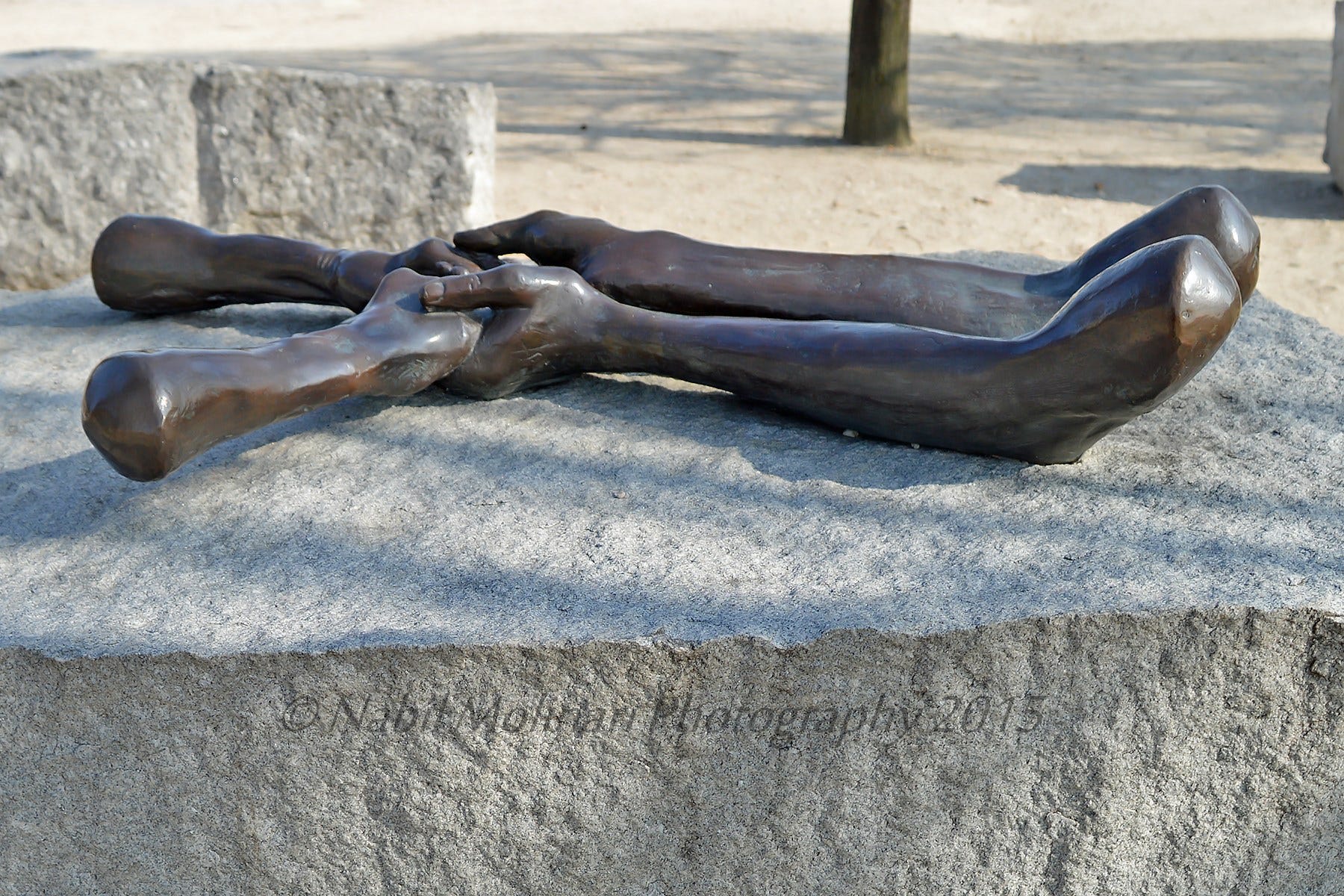
One finds mention of several art works, say Louise Bourgeois’s The Welcoming Hands (1996), and an array of literature, too, in the book, and, in noticing them, I felt if the novelist was trying to comment on how art is (mis)construed and how an artwork’s projection in curatorial notes, or what is talked about them, seem meaningless if there isn’t an individualistic meaning or experience the observer can attach to it. Would you agree?
What an interesting question. Yes, I agree! This makes me think of Barthes’ Camera Lucida: the idea (which I’m sure I’m not doing justice to in my retelling) that photographs always contain various general cultural/historic/artistic features, that lots of people would perceive in the same way, and have some degree of interest in, but that they also contain a ‘punctum’, some particular accidental, evocative detail that moves an individual viewer for a reason that might be unclear or unconscious, and that’s purely personal, and driven by emotions and not knowledge.
I feel that my book is very interested in the punctum response, and not at all in the former, ‘studium’ response—and that’s why the narrator often seems a bit dismissive of things like curatorial notes. I’m thinking of this also in relation to the moment when Luke takes her to a hill with a view of his childhood city, and for a moment she perceives it as a neutral cityscape—“I saw generic things, the silhouette of the cathedral, I saw things which were in no sense for or about me, things which would interest many people to a small and forgettable degree”—before she begins, once again, to experience it on the personal, emotional, intuitive level, which holds so much more value to her, and so much more value within the novel.
Which literary works created an impression on you and what can readers expect from you next?
To Rest Our Minds and Bodies was inspired by The Catcher in the Rye and The Bell Jar, and also by Clarice Lispector and Virginia Woolf; by Elif Batuman, Sheila Heti, Chris Kraus, Claire-Louise Bennett, Mieko Kawakami, Miranda July1, and many more!
I’m working on a novel, now, which is quite different—with Bret Easton Ellis, Karl Ove Knausgård’s Morning Star series, and the works of Ottessa Moshfegh and Ben Lerner as key internal reference points, and also the psychoanalytic works of Donald Winnicott, and Alison Bechdel’s amazing graphic novel memoirs, [which are] really important in how I am thinking about childhood in this new book.
A short story titled Something that Needs Nothing by Miranda July, which was published in The New Yorker, on 11 September 2006, finds a mention in the book.